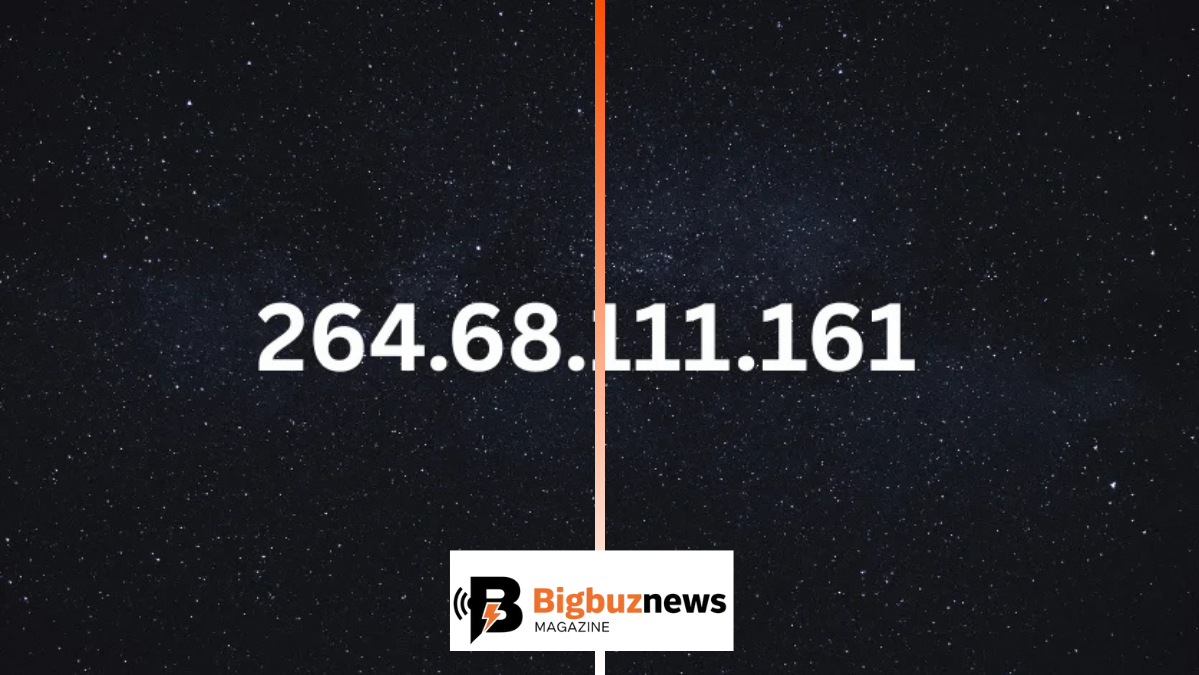
In today’s digital landscape, every IP address carries a story, a purpose, and a place in the vast network of the internet. One such identifier that has recently piqued interest is 264.68.111.161. While on the surface, it may appear as just a string of numbers, IP addresses like this one play crucial roles in networking, cybersecurity, and online communication. In this article, we’ll explore 264.68.111.161 in depth, highlighting its significance, potential uses, and what makes it noteworthy in technical discussions.
What is 264.68.111.161?
At its core, 264.68.111.161 is formatted like a typical IPv4 address, which is the most widely used version of IP addresses. IP addresses act as unique identifiers for devices connected to the internet, allowing them to communicate efficiently. Every device, whether it’s a smartphone, computer, or server, relies on IP addresses to send and receive data.
However, a closer look at 264.68.111.161 reveals something unusual: the number 264 in the first octet exceeds the maximum valid range of 0–255 for IPv4 addresses. This immediately suggests that 264.68.111.161 is not a standard, valid IPv4 address. Experts often analyze such addresses to understand potential errors, testing environments, or fictional placeholders used in network simulations.
Despite being invalid in practical networking, studying 264.68.111.161 provides valuable insights into IP addressing rules, the importance of validation in network systems, and the potential implications of misconfigured addresses. It’s a reminder of how even small errors in IP assignment can disrupt connectivity and communication.
Common Misconceptions About IP Addresses Like 264.68.111.161
Many people assume that any sequence resembling an IP address is automatically valid. Seeing 264.68.111.161, some might try to ping it or trace its location. In reality, this address falls outside the acceptable range for IPv4. This common misconception underscores the importance of understanding IP address formats and subnet rules.
IP addresses are divided into four “octets,” each ranging from 0 to 255. The first octet, in particular, determines the class of the address, which affects routing and network design. Since 264 exceeds 255, this address cannot exist in real-world networks. Such addresses often appear in testing documentation, tutorials, or fictional examples where the goal is to illustrate concepts without using real-world addresses.
Another misconception is that invalid addresses like 264.68.111.161 might be linked to hacking or suspicious activity. While some IP addresses are indeed flagged for malicious use, this specific sequence is most likely an accidental or illustrative placeholder rather than an active participant in internet traffic. This highlights why network professionals must verify IP addresses before using them in practical applications.
Technical Insights and Implications
Even though 264.68.111.161 is invalid, exploring its structure can help us understand critical networking principles. For instance, network administrators must ensure that every device receives a valid IP address to avoid conflicts or connection failures. Assigning an address outside the valid range could cause network errors or prevent devices from accessing the internet.
Moreover, analyzing addresses like 264.68.111.161 is important for software developers and cybersecurity specialists. Many testing environments deliberately use invalid or out-of-range IPs to simulate errors, evaluate firewall responses, and strengthen system validation mechanisms. This practice ensures that real-world networks remain secure and robust against misconfigurations.
From a theoretical perspective, addresses like this remind us that the IPv4 space is limited. With only around 4.3 billion possible addresses, every octet must stay within its valid range. The existence of 264.68.111.161 as an outlier reinforces the importance of careful address allocation, especially in enterprise networks and large-scale cloud infrastructures.
Potential Use Cases in Learning and Testing
While you can’t route data to 264.68.111.161 in a live network, it has value in educational and experimental contexts. Networking courses, labs, and online tutorials often use out-of-range IPs to demonstrate error handling, IP validation, and subnetting exercises. By interacting with invalid addresses, students learn to troubleshoot effectively and understand why network protocols enforce strict rules.
Developers also use fictional IPs like 264.68.111.161 in software testing, especially when creating applications that require IP input validation. By testing against invalid ranges, they ensure that systems can gracefully handle incorrect data without crashing or exposing vulnerabilities. Such testing is crucial in building robust network tools, web servers, and cybersecurity solutions.
Furthermore, cybersecurity simulations may employ invalid IPs to teach students about common misconfigurations. For example, firewalls can be tested to ensure they reject invalid traffic, while network monitoring tools can flag anomalies, mimicking real-world defensive strategies. This makes 264.68.111.161 more than just a string of numbers—it becomes a practical learning tool.
Conclusion: Why 264.68.111.161 Matters
At first glance, 264.68.111.161 may seem irrelevant due to its invalid range. Yet, its existence sparks valuable discussions about IP addressing rules, network validation, and error handling. It serves as a reminder that networking relies on precision, and even a single number out of range can prevent connectivity and create confusion.
For professionals, enthusiasts, and learners, analyzing addresses like 264.68.111.161 emphasizes the importance of understanding network fundamentals. It also showcases how mistakes—or intentional placeholders—can serve educational and testing purposes. In a world increasingly reliant on digital communication, every IP address, whether valid or not, has a lesson to offer.
Ultimately, 264.68.111.161 teaches us that knowledge of IP standards is essential for maintaining secure, efficient, and functional networks. By examining such examples, we sharpen our understanding of technology, improve troubleshooting skills, and appreciate the structured complexity that underpins the internet.