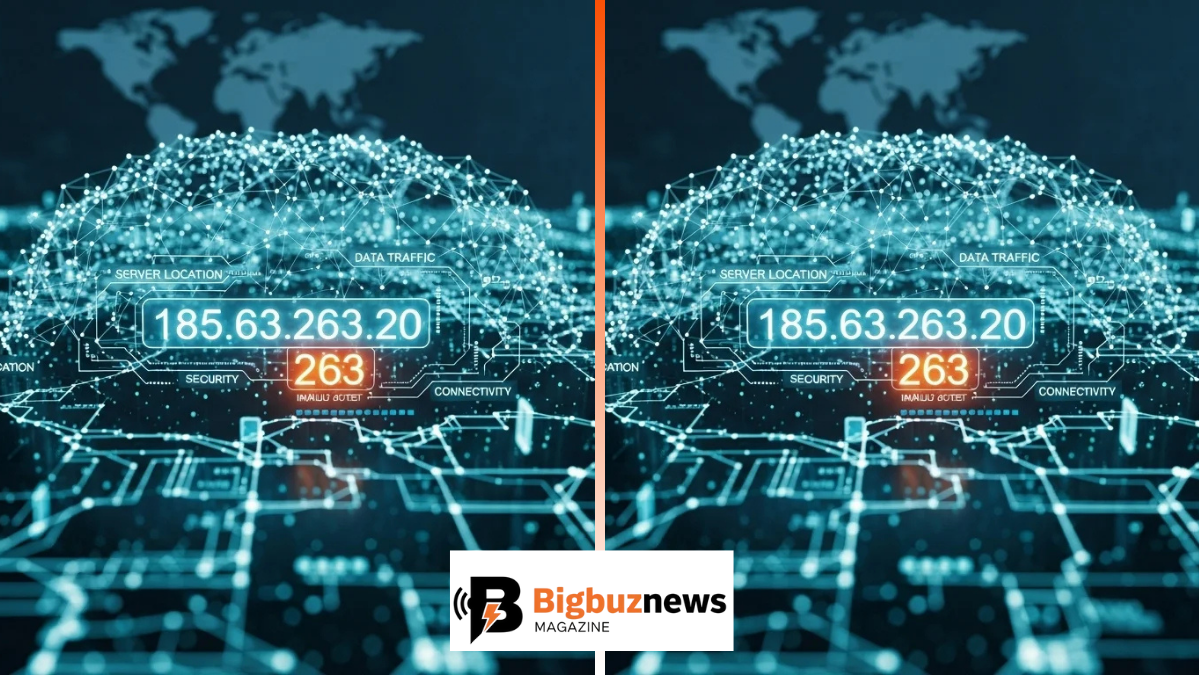
In today’s digitally connected world, IP addresses are the backbone of the internet. Every website you visit, every email you send, and every online transaction you make relies on these numeric identifiers. One such example is 185.63.263.20, a seemingly random string of numbers that represents a unique identifier in the online ecosystem. While this specific address is technically hypothetical due to the 263 value exceeding the standard IPv4 limit, it provides an excellent case study for understanding IP addresses, their functions, and their implications for security and connectivity.
Understanding IP Addresses
An IP address, short for Internet Protocol address, is a unique numerical label assigned to each device connected to a computer network that uses the Internet Protocol for communication. Essentially, it acts as an identifier, allowing devices to locate and communicate with each other over the internet.
IPv4, the most common IP standard, consists of four numbers separated by periods, each ranging from 0 to 255. While 185.63.263.20 exceeds the valid range in one of its octets, it serves as a good hypothetical example for discussing how IPs are structured. These addresses are critical for routing data packets accurately from the source to the destination, ensuring smooth online communication.
Without IP addresses, the internet as we know it would be chaotic. Each device would struggle to find other devices or servers, making even simple tasks like browsing a webpage impossible. This illustrates why understanding IP addresses, even hypothetical ones like 185.63.263.20, is foundational for anyone interested in networking or cybersecurity.
Types of IP Addresses
IP addresses can be classified into several types, each serving different purposes. One of the most important distinctions is between static and dynamic IP addresses. A static IP address is permanent and remains consistent over time, making it ideal for businesses hosting websites or services that require constant accessibility. Dynamic IP addresses, on the other hand, change periodically and are often assigned by Internet Service Providers (ISPs) to residential users.
Additionally, IP addresses can be public or private. Public IPs, such as our hypothetical 185.63.263.20, are accessible from the internet, while private IPs are confined to local networks. Understanding these distinctions is crucial for configuring networks securely and efficiently. For example, a server with a public IP must be well-protected, as it is exposed to potential external threats, whereas private IPs are shielded from direct internet access.
Finally, there are IPv6 addresses, which are becoming increasingly important due to IPv4 address exhaustion. While IPv4 uses a 32-bit format, IPv6 employs a 128-bit format, allowing for an almost infinite number of addresses. In this context, 185.63.263.20 highlights the limitations of IPv4 and the need for future-proof solutions in networking.
Tracing and Locating IP Addresses
One common use of an IP address like 185.63.263.20 is for tracing its origin. IP tracing involves determining the geographical location, ISP, and sometimes the organization associated with a particular IP. This can be useful for cybersecurity investigations, website analytics, or even legal purposes.
However, tracing an IP address is not always precise. Factors such as VPN usage, proxy servers, and dynamic IP allocation can obscure the actual location of a device. In the case of 185.63.263.20, even if it were valid, its origin could only be pinpointed within a certain range, often limited to the city or region. Despite these limitations, IP tracing remains a vital tool for network administrators and security professionals aiming to monitor traffic and detect suspicious activity.
Moreover, understanding the basics of IP geolocation helps businesses optimize their services. For instance, online retailers can provide location-specific offers or faster server responses by knowing the IP addresses of their visitors. This further emphasizes the practical importance of studying addresses like 185.63.263.20, even as theoretical examples.
Security Implications of IP Addresses
Every IP address carries potential security risks, and 185.63.263.20 is no exception in a hypothetical scenario. Hackers and cybercriminals often target IP addresses to exploit vulnerabilities, launch Distributed Denial-of-Service (DDoS) attacks, or attempt unauthorized access. This is why organizations invest heavily in firewalls, intrusion detection systems, and secure network configurations.
On an individual level, understanding your own IP address can help you protect your online privacy. For instance, masking your real IP with a VPN ensures that websites cannot track your location, making it harder for attackers to target you. Similarly, monitoring unusual access attempts to your IP can alert you to potential threats before they escalate.
In cybersecurity training, hypothetical IPs like 185.63.263.20 are often used to simulate real-world scenarios without compromising actual network security. These simulations allow professionals to test defense mechanisms, study attack vectors, and prepare for possible breaches in a controlled environment.
Conclusion: The Significance of IP Awareness
While 185.63.263.20 is not a valid IP, it provides a useful lens through which to explore the complex world of networking, geolocation, and cybersecurity. IP addresses are far more than random numbers—they are the essential identifiers that enable devices to communicate effectively, businesses to operate online, and security professionals to protect networks.
By understanding how IP addresses work, the different types that exist, and their potential security implications, both individuals and organizations can make informed decisions about network setup, data protection, and online privacy. Even a hypothetical IP like 185.63.263.20 serves as a reminder of the intricacies behind the seamless digital experiences we often take for granted.
In a world where connectivity is king, knowledge of IP addresses is no longer optional—it’s a fundamental part of navigating and securing the digital landscape.